Description
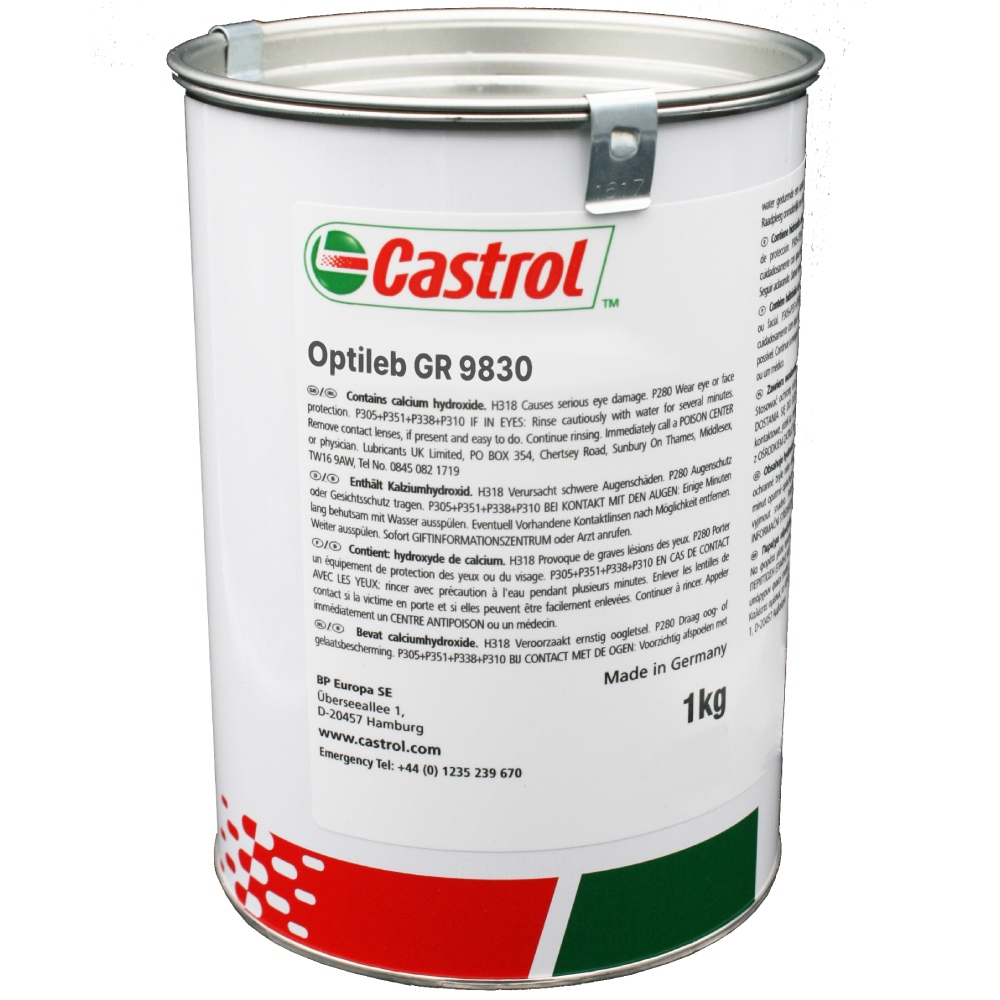
Castrol Optileb™ GR 9830 (previously called Molub-Alloy™ Foodproof 9830) is a special high-temperature grease (NLGI grade 2) formulated from a synthetic oil and solid lubricants (PTFE), developed for the lubrication of rolling and sliding bearings. The grease is excellently suited for high-temperature applications in the food and beverage industries where minimum lubricant consumption, drip-free lubrication and physiological safety are required. It can also be used as a safety sliding agent for oxygen installations.
Application
- Especially suited for applications in baking and drying ovens in the food and canning industries.
- Due to its low volatility, is also suited for vacuum applications, e.g. coating installations.
- May be used in continuous service up to 250°C and be exposed to temperatures up to 280°C for short-time applications.
Advantages
- Aging resistance at high temperatures
- Thermal and chemical stability
- Resistant to most solvents, even chlorinated hydrocarbons, strong acids, alkalis and oxidizing agents, e.g.: acetone, benzene, benzol, boron trifluoride, bromine, chlorine, chlorobenzene, cyclohexane, dioxan, natural gas, ethylene acetate, fluorine, halogens, potassium hydroxide, methylene chloride, methyl formiate, sodium hydroxide, perchloro-ethylene, petroleum ether, hydrochloric and sulphuric acid, tetrahydrofurane, toluol, 1.1.1. trichlorethane, trichlorethylene, xylol
- Excellent lubricating properties – as measured by standard laboratory tests and extensive field evaluations
- Extended relubrication intervals without undue risk of lubricant starvation or increased lubricant consumption
- Below 280°C the lubricant resists the thickening and hardening which is typical of mineral oil products in hightemperature applications
- Minimum consumption, economic application and clean operating conditions
- Compatible with the following sealing materials: NBR, EPDM, NR, MWQ, PVMQ, PA, PE, PUR, PTFE
- Physiologically safe; approval by LGA (Bavaria)
Technical specifications
- Colour: White
- Density @ 15°C / 59°F kg/m³: 1930
- Worked Penetration (60 strokes @ 25°C / 77°F) 0.1 mm: 265-295
- Thickener type: PTFE
- Base Oil Viscosity @ 40°C / 104°F mm²/s: 510
- Base Oil Viscosity @ 100°C / 212°F mm²/s: 46
- Base Oil Viscosity @ 200°C / 392°F mm²/s: 6.5
- Viscosity Index: 135
- Flash Point – open cup method °C/°F: non-flammable
- Pour Point °C/°F: -20/-4
- Volume: 1kg tin
- GLIS number: 15D691
- MSDS code: 468605
Additional Information
- Clean-up may be difficult because of the excellent resistance to ordinary cleaners and solvents. Use special solvents.
- Where lubricants may come in contact with products (e.g. food, textiles etc.) good effective sealing and handling procedures should be maintained.
- At continuous operating temperatures above 250°C, very small amounts of toxic vapors may develop due to chemical changes; forced draft ventilation is then necessary